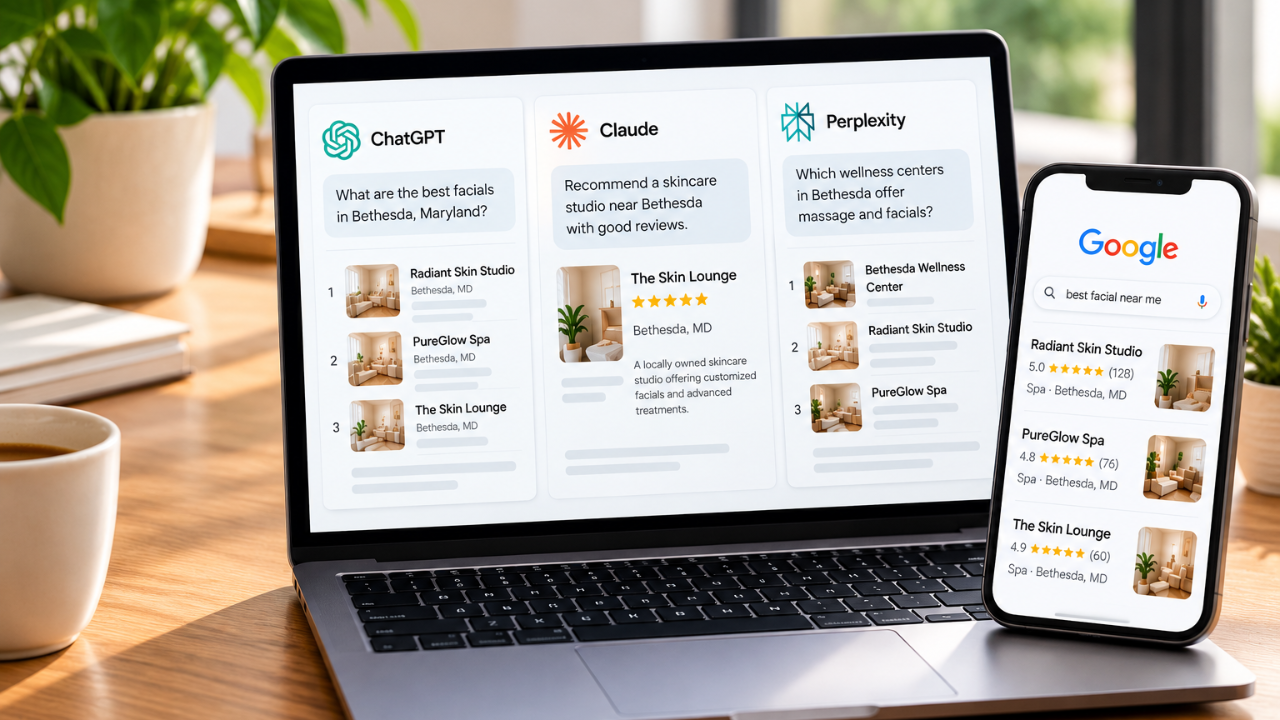
Someone opens ChatGPT and asks, "Can you recommend a good facial spa in Bethesda, Maryland?"
Another person asks Perplexity, "Soul Food restaurant in Los Angeles offering catering for 500 people?"
Someone else asks Google, "Recommend affordable digital marketing and AI visibility company near me?"
Instead of scrolling through a list of websites, these people may receive an AI-generated answer recommending specific businesses.
Is your business one of them?
That's becoming an important question for small business owners. And it's one I was recently asked during a client meeting.
The conversation wasn't just about getting recommended by ChatGPT. It was about something much simpler: How can a small business owner find out if their business is appearing in AI search without spending hundreds of dollars on tracking software?
The good news is that you don't necessarily need expensive software to get started. You can check your visibility yourself, use a free spreadsheet to monitor the results, or try one of several paid tracking platforms. But there's another question that's just as important.
Once you find out if your business is appearing in AI search, what are you supposed to do with that information? Let's quickly walk through it.
What Is AI Search Visibility Tracking?
AI search visibility tracking is simply checking if your business is mentioned or recommended when someone asks an AI platform a question related to your products or services.
For example, imagine you own a massage therapy business in Bethesda, Maryland.
A potential customer might ask:
-
"Where can I get a deep tissue massage in Bethesda?"
-
"Recommend a massage therapist near me with good reviews."
-
"Which wellness centers in Bethesda offer massage and stretching services?"
-
"Where can I book a massage appointment this weekend?"
You want to know if ChatGPT, Claude, Perplexity, Gemini, or Google's AI search features mention your business when answering these questions. You also want to know which competitors are appearing instead. That's what AI search tracking helps you monitor.
Keep in mind that AI answers can change. Two people asking the same question may receive different recommendations depending on the platform, location, available information, and other factors.
One mention doesn't mean your business always appears, and one missing mention doesn't mean your business is invisible.
That's why tracking the same questions over time is more useful than checking once.
How Much Does It Cost to Track Your Business in AI Search?
Some of the biggest SEO software companies now offer AI visibility tracking.
But if you're a small business owner who only wants to know if your company is being mentioned in AI search, some of these subscriptions may be more than you need.
Here are several examples of advertised monthly pricing as of October 2026.
| Platform | Monthly Price | AI Tracking Allowance |
|---|---|---|
| AEO Copilot Free | $0 | 50 prompts/month |
| AEO Copilot Startup | $9 | 50 prompts/month |
| AEO Copilot Freelancer | $34 | 250 prompts/month |
| Ahrefs Lite | $129 | 150 AI prompt checks/month |
| Semrush Starter SEO + AI | $199 | 50 prompts tracked daily |
| Semrush Pro+ SEO + AI | $299 | 100 prompts tracked daily |
These plans include different features, tracking frequencies, and methods of counting prompts. Pricing and allowances may change. Ahrefs and Semrush also include broader SEO tools, so they are not direct equivalents to a dedicated AI monitoring service.
You can review the platforms here: AEO Copilot, Ahrefs, Semrush
Why Does One AI Tracking Tool Cost $9 and Another Cost $199?
You're not necessarily paying for the same thing. Some platforms provide a complete set of SEO tools, including keyword research, competitor analysis, website audits, and search ranking reports.
Others focus primarily on checking how businesses appear in AI-generated answers.
For example, Ahrefs and Semrush offer tools that can help businesses research keywords, monitor competitors, and identify website problems in addition to their AI tracking capabilities.
But if all you want to know is if ChatGPT or Perplexity is recommending your business, paying for a full SEO software package may not make financial sense.
Start by identifying what information you actually need before paying for a subscription.
AEO Copilot: What's the Difference Between the Free and $9 Plans?
AEO Copilot is one of the lower-priced AI search tracking options I've reviewed.
Interestingly, both its free and $9 Startup plans advertise 50 prompts per month.
So why pay $9? The difference is in the features. The free plan offers monthly tracking for one brand across ChatGPT and Claude. The $9 Startup plan offers weekly tracking, a choice of additional AI platforms, and access to features such as exporting results.
In other words, you're paying for more frequent checks and additional capabilities, not necessarily more questions.
For a small business owner just starting out, the free plan may be enough.
Before subscribing, check how the company counts its monthly prompt allowance and which platforms are included.
What Does "50 AI Prompts" Actually Mean?
This is where AI tracking software can become confusing.
A prompt is simply a question or instruction someone gives an AI platform.
For example: "Which wellness spas in Bethesda offer facials and massage therapy?"
That's one prompt.
"Recommend a restaurant in Inglewood that provides catering for large family gatherings."
That's another prompt.
When tracking AI visibility, you're testing questions that potential customers might ask.
However, 50 prompts doesn't always mean 50 different questions checked across every AI platform as often as you want.
Some software companies count the questions you monitor. Others count how many times those questions are checked across different platforms.
Let's say you want to monitor:
-
10 customer questions
-
Across 4 AI platforms
-
Once every week
That's potentially 40 individual checks per week, or about 160 checks over four weeks.
How those checks count toward your subscription depends on the provider. That's something you should understand before paying.
How to Track Your Business in AI Search for Free
You don't need to purchase software to begin checking your AI search visibility.
You can do it yourself using ChatGPT, Claude, Perplexity, and Gemini.
Yes, it takes some time, but it can give you a useful starting point.
Step 1: Come Up With 10 Questions Your Customers Might Ask
Think about what someone would type into an AI platform when looking for your services.
If you own a skincare business, your questions might include:
-
Where can I get a customized facial in Bethesda?
-
What are the best skincare studios near Marina Del Rey, California?
-
Which local spas offer microcurrent facial treatments?
-
Where can I book a facial for sensitive skin in Santa Monica?
-
Recommend a skincare specialist in Bethesda with good reviews.
Start with 10 questions. You can expand to 25 or 50 later.
Avoid asking questions that already contain your business name, such as "Tell me about ABC Skincare." That only tells you if the platform recognizes your business when you mention it directly.
You want to find out if AI recommends your business when someone is looking for a service you offer.
Step 2: Search Your Questions Across AI Platforms
Open ChatGPT, Claude, Perplexity, or Gemini and enter your questions.
For a more consistent test, use a fresh conversation without your previous chat history.
Where available, use guest access, temporary chats, or a private browser window.
Keep in mind that incognito mode doesn't completely remove location information or every form of personalization. Some platforms may also require you to sign in.
Record the date, platform, and exact question you asked.
Step 3: Record Which Businesses Are Mentioned
For each question, look at the response.
- Did the AI mention your business?
- Did it recommend your competitors?
- Did it link to your website or another source?
- Did it provide accurate information about your services?
You don't need anything complicated to start recording this information. A Google Sheet works perfectly well.
Step 4: Use a Free AI Search Visibility Spreadsheet
I've created a simple AI Search Visibility Tracker that small business owners can use to record their results.
You can track:
-
Questions you're testing
-
AI platforms you're checking
-
Dates you performed the searches
-
Mentions of your business
-
Competitors appearing in the results
-
Websites or sources referenced
-
Changes you notice over time
[Get the Free AI Search Visibility Tracker]
You can make a copy in Google Sheets and start entering your results.
Step 5: Repeat the Process Every Month
You don't need to check your business every day. For most small businesses starting out, checking once a month is a reasonable approach.
Use the same questions and platforms so you can compare your results.
If your business wasn't mentioned last month but appears this month, that's something worth investigating.
If competitors consistently appear instead of your business, look at what information AI platforms are using to recommend them.
The objective isn't to check your results constantly. It's to identify patterns that can help you make better marketing decisions.
Can You Automate AI Search Tracking Without Paying for Software?
This is another question worth asking. If ChatGPT and other AI platforms can research information, can't you simply ask them to check your business automatically?
You can automate parts of the process, but there are limitations.
For example, ChatGPT offers scheduled tasks that can run certain research requests on a recurring schedule.
You could ask it to research how your business appears for a list of customer questions every Monday. However, that doesn't mean it can reliably test every AI platform exactly as a dedicated tracking service would.
A ChatGPT research task isn't the same as independently checking what Claude, Perplexity, and Gemini recommend to customers.
You may also encounter differences in access, search results, location, and personalization.
For that reason, I'd treat AI-assisted monitoring as a way to save time rather than a complete replacement for dedicated tracking software.
An Example AI Tracking Request
You could try asking: "Every Monday, research how my business appears in AI search for these 10 customer questions. Identify mentions of my business, competitors appearing in the results, and any websites being referenced. Compare the findings with previous reports when possible. Clearly identify anything you couldn't verify."
You would need to provide your business details and the questions you want monitored.
If your AI platform supports scheduled tasks, you may be able to automate parts of this process.
Otherwise, you can save the request and run it manually.
Don't assume an automated report has checked every platform unless it clearly explains how those checks were performed.
What Should You Do If AI Doesn't Recommend Your Business?
This is the part I believe deserves more attention. You could spend $9, $99, or even $299 per month tracking your AI visibility. But what happens when the reports show that your business isn't appearing?
Tracking software tells you what it's finding. It doesn't automatically fix the reasons your business may be missing.
Here's what I would investigate.
1. Look at Your Website Content
Does your website clearly explain what you offer, who you help, and where you provide your services?
For example, a wellness spa might have a page simply titled "Facials." But does that page explain the types of facials available, the skin concerns they address, and the city where the business operates?
Specific, helpful information gives both customers and search platforms more context about your business.
2. Review Your Google Business Profile and Business Listings
If you serve customers in a particular city, your local business information should be accurate and consistent.
Review your business name, address, phone number, services, hours, category, and website links.
Also look at other websites that mention your business.
AI search platforms may use information from websites, business directories, reviews, and other sources when preparing responses.
3. Look at the Competitors Being Recommended
If the same competitor appears repeatedly, visit their website.
- What information do they provide that yours doesn't?
- Do they have detailed service pages?
- Are they mentioned by local organizations or publications?
- Do they have customer reviews discussing the services people are searching for?
The objective isn't to copy your competitors. It's to identify information your own website or online presence may be missing.
4. Look at the Sources AI Is Using
Some AI platforms display links to the websites used in their answers. Pay attention to those links.
Are they pointing to local business directories, review platforms, news articles, or individual business websites?
Those sources can help you understand where AI is finding information about businesses in your industry.
5. Measure More Than AI Mentions
Appearing in an AI response is encouraging. But it doesn't automatically mean someone visited your website, called your business, booked an appointment, or made a purchase.
You should also be monitoring website traffic, customer inquiries, form submissions, phone calls, and bookings.
Google Analytics and Google Search Console can help you understand parts of that activity. The goal isn't simply to be mentioned by AI.
The goal is to attract people who may become customers.
Can a Small Service Business Compete With Big Brands in AI Search?
Yes, small businesses can compete for relevant recommendations, particularly when people are searching for specific services in specific locations.
Imagine someone asks: "Where can I get a microcurrent facial in Bethesda, Maryland?"
A local skincare studio that clearly explains its microcurrent treatments, location, and appointment options may be more relevant to that request than a large national skincare brand.
That doesn't guarantee the local business will be recommended. But it illustrates why small businesses shouldn't assume AI search is only for large companies with enormous marketing budgets.
You can improve the information available about your business without spending thousands of dollars on advertising or public relations.
For more ideas, read our article about building visibility on Google and AI search without a big PR budget.
When You Need More Than an AI Search Tracking Tool
Monitoring your AI search visibility is one part of understanding how people find your business. But small businesses also need help turning that visibility into actual inquiries and customers.
For example, what happens when someone finds your website but doesn't book an appointment?
- What if visitors are interested in your services but leave without providing their email address?
- What if your website receives traffic, but you don't know which pages are generating inquiries?
Those are marketing problems that an AI tracking tool alone won't solve.
At Mastering P.O.P, we provide ongoing digital marketing coaching for small businesses starting at $249 per month. Our coaching goes beyond AI search visibility.
We help business owners work on their website SEO, Google Business Profile, content marketing, email marketing, customer lead capture, Google Analytics, Search Console, partnerships, and other areas of their marketing.
We also help businesses understand and make better use of the systems they already have, including booking platforms and point-of-sale systems.
Members receive live Zoom coaching, opportunities to ask questions between sessions, and personalized keyword ranking reports.
Instead of paying for multiple tools without knowing what to do with the information, you have someone to help you understand the results and identify your next steps.
Learn More About Mastering P.O.P.'s Digital Marketing Coaching
Have a Franchise or Business Network? We Can Help Your Members, Too.
If you operate a franchise, salon suite, wellness center with independent contractors, or business network, why not offer your business owners and service providers access to affordable digital marketing coaching?
Many are responsible for attracting their own customers but don't have the marketing knowledge or support to do it effectively.
You don't want the businesses in your network making marketing decisions without understanding what's working, do you?
Mastering P.O.P. offers digital marketing coaching programs specifically for franchises, business networks, and organizations with independent operators.
Your participating business owners receive ongoing training, personalized keyword ranking reports, live Zoom coaching, and access to ask marketing questions between sessions.
We offer a preferred partner program starting at $299 per month per participating business, along with company-sponsored options for organizations that want to provide marketing support across their network.
When your business owners attract more customers and grow, your entire network benefits.
Explore Our Franchise & Business Network Programs
Frequently Asked Questions About AI Search Tracking
Can I check if my business appears in ChatGPT for free?
Yes. You can manually ask ChatGPT questions that potential customers might use when searching for your products or services. Record the results and repeat your searches over time. Keep in mind that responses can vary.
Do I need to track 50 AI prompts?
No. Start with 10 questions closely related to your services, location, and customers. Expand your list when you have a reason to monitor additional searches.
Is AI search tracking software worth paying for?
It depends on how many questions, businesses, and AI platforms you need to monitor. A business owner tracking 10 questions monthly may be fine with a free spreadsheet. An agency managing many businesses may benefit from automated tracking and reporting.
Which agencies can help small businesses improve visibility across Google, Maps, and AI search without a huge budget?
Look for a provider that works on website SEO, local business visibility, useful content, and performance measurement, not just AI mentions.
Mastering P.O.P offers affordable ongoing digital marketing coaching for small businesses that want help understanding their online visibility and improving their marketing.
What resources can help a small business build an AI search strategy without a large budget?
Start with free resources such as Google Search Console, Google Analytics, your Google Business Profile, and a spreadsheet for monitoring AI recommendations.
You can also read our article on how to get your business recommended by ChatGPT and other AI search platforms.
These resources can help you understand your current visibility before deciding if additional software or coaching would be useful.
Start Tracking Before You Start Spending
You don't need to spend hundreds of dollars every month just to find out if your business is appearing in AI search.
- Start with a few questions your customers might ask.
- Check the responses.
- Record the results.
Look at the businesses being recommended and the sources being used. Then use that information to decide where your website and marketing need attention.
If you eventually need more frequent monitoring, a paid platform may save you time. But remember, knowing that your business isn't appearing in AI search is only the beginning. Improving your online presence is where the real work starts.
And that's something you can begin working on without a huge marketing budget.