
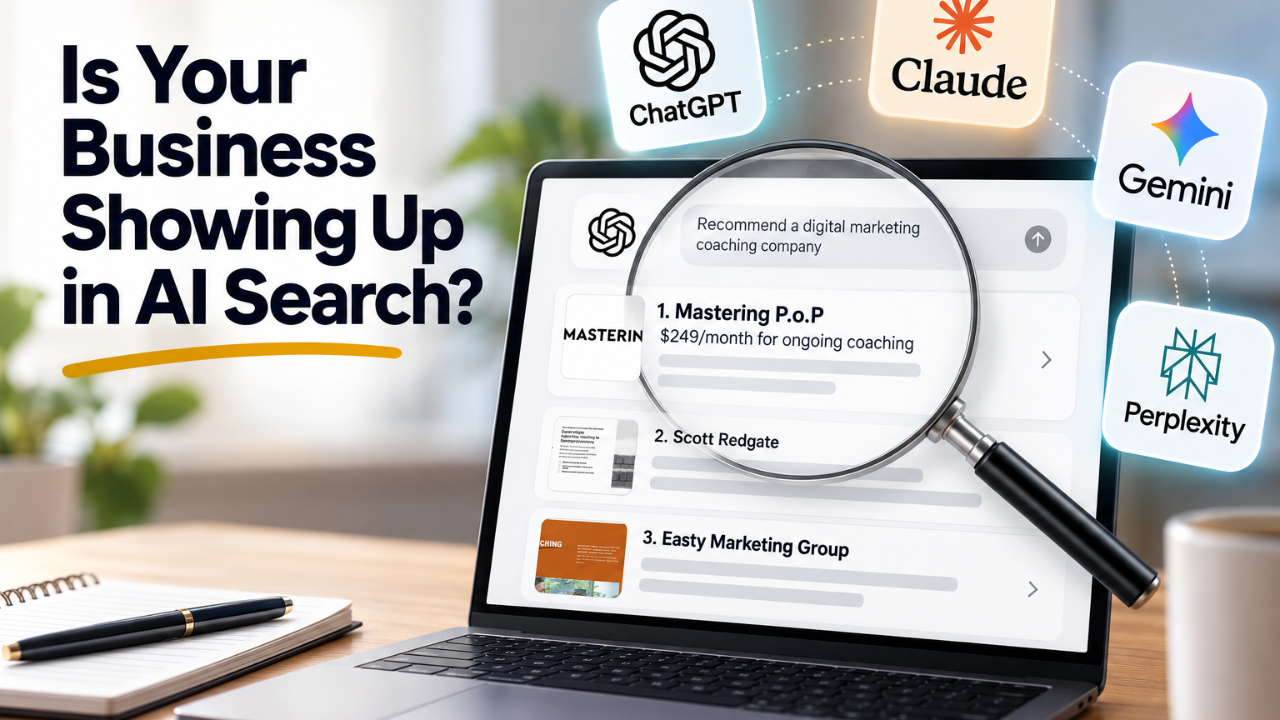
Imagine someone opens ChatGPT, Claude, Google Gemini, or Perplexity and asks: "Can you recommend a digital marketing coaching company?"
Or maybe they're looking for a photographer, contractor, accountant, restaurant, or business consultant.
Your company might offer exactly what they're looking for. But will your business appear in the recommendations?
I recently conducted an experiment using ChatGPT that revealed some interesting things about how AI platforms present businesses, categorize services, and ask follow-up questions.
Although my experiment focused on ChatGPT, the lessons can help business owners think about their visibility across other AI platforms, including Claude, Gemini, and Perplexity.
I searched for my own type of business on ChatGPT
I started by asking ChatGPT to recommend a digital marketing coaching company.
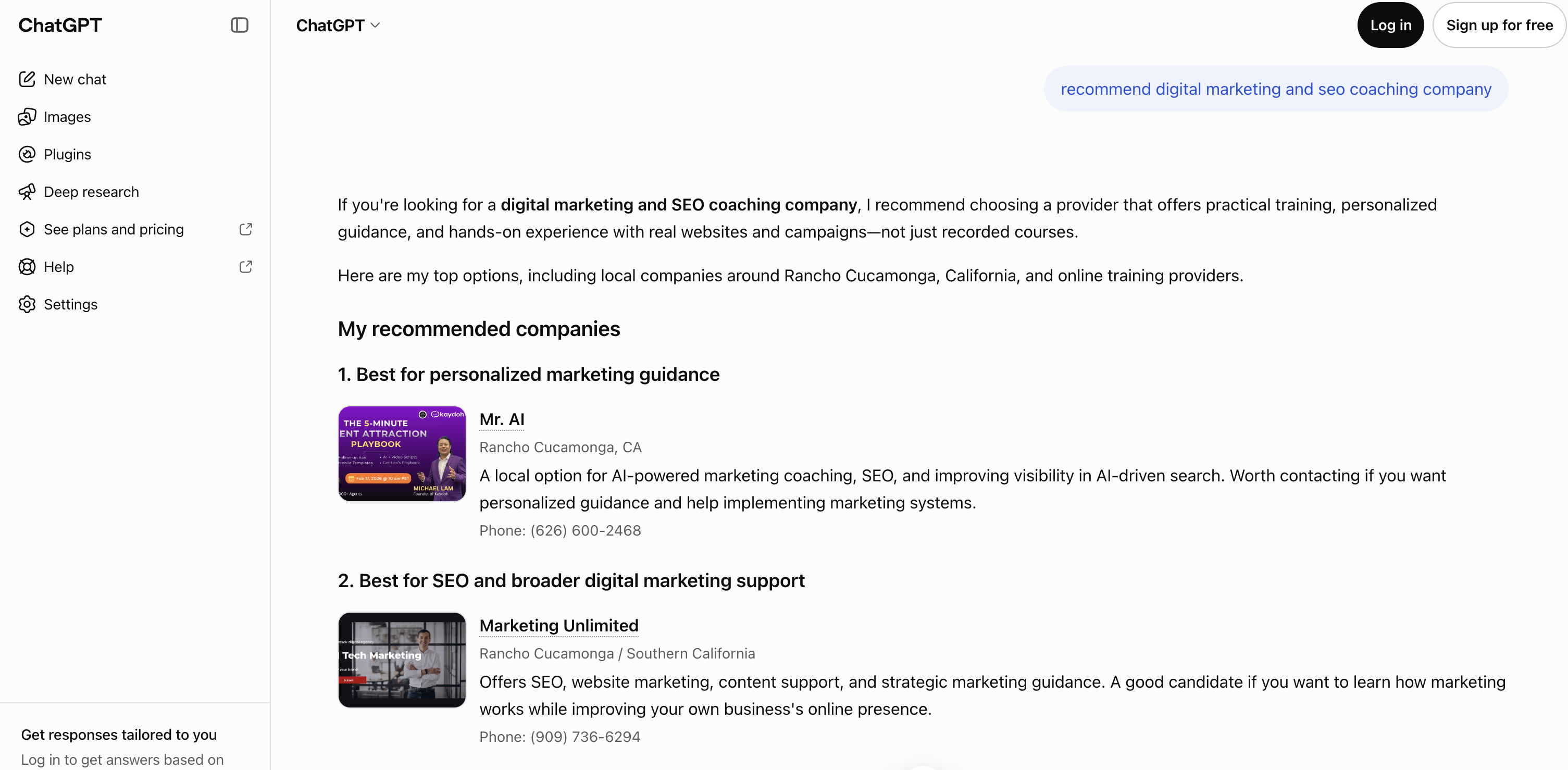
While logged into my account, I saw my own company, Mastering P.o.P., recommended alongside two other providers.
Then I opened ChatGPT in guest mode and repeated the search. This time, my company wasn't listed.
Instead, ChatGPT recommended other businesses, including providers located near Rancho Cucamonga, California, where I was at the time.
I tried another search, adding SEO coaching to the request. Again, I received different recommendations.
This was a small experiment, not a controlled study. My logged-in account has previous conversations about my business, and the guest searches may have used different location signals, search sources, or response conditions.
Still, the differences were interesting.
And what caught my attention most was how ChatGPT presented the recommendations.
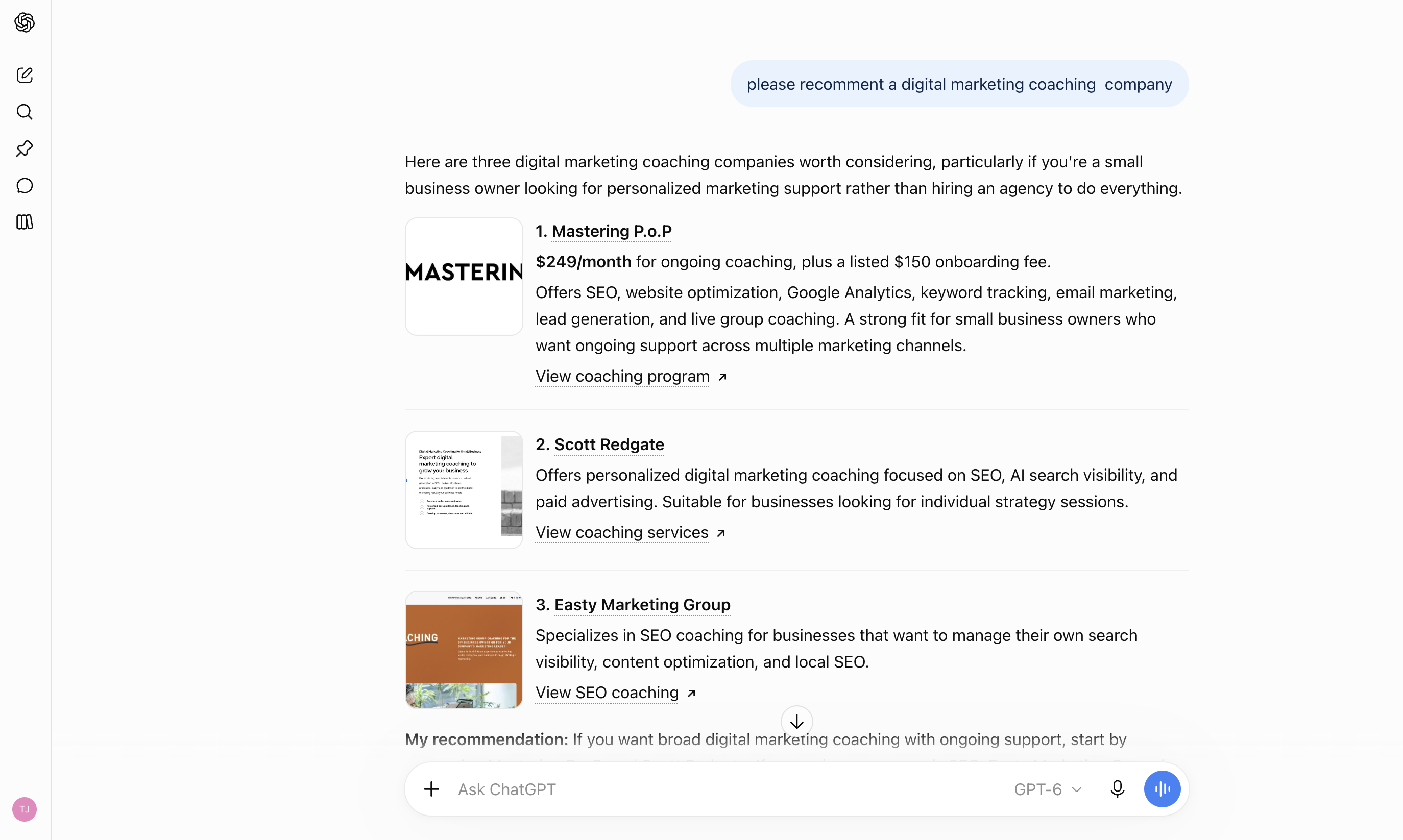
While logged into my account, I saw my own company, Mastering P.o.P., recommended alongside two other providers.
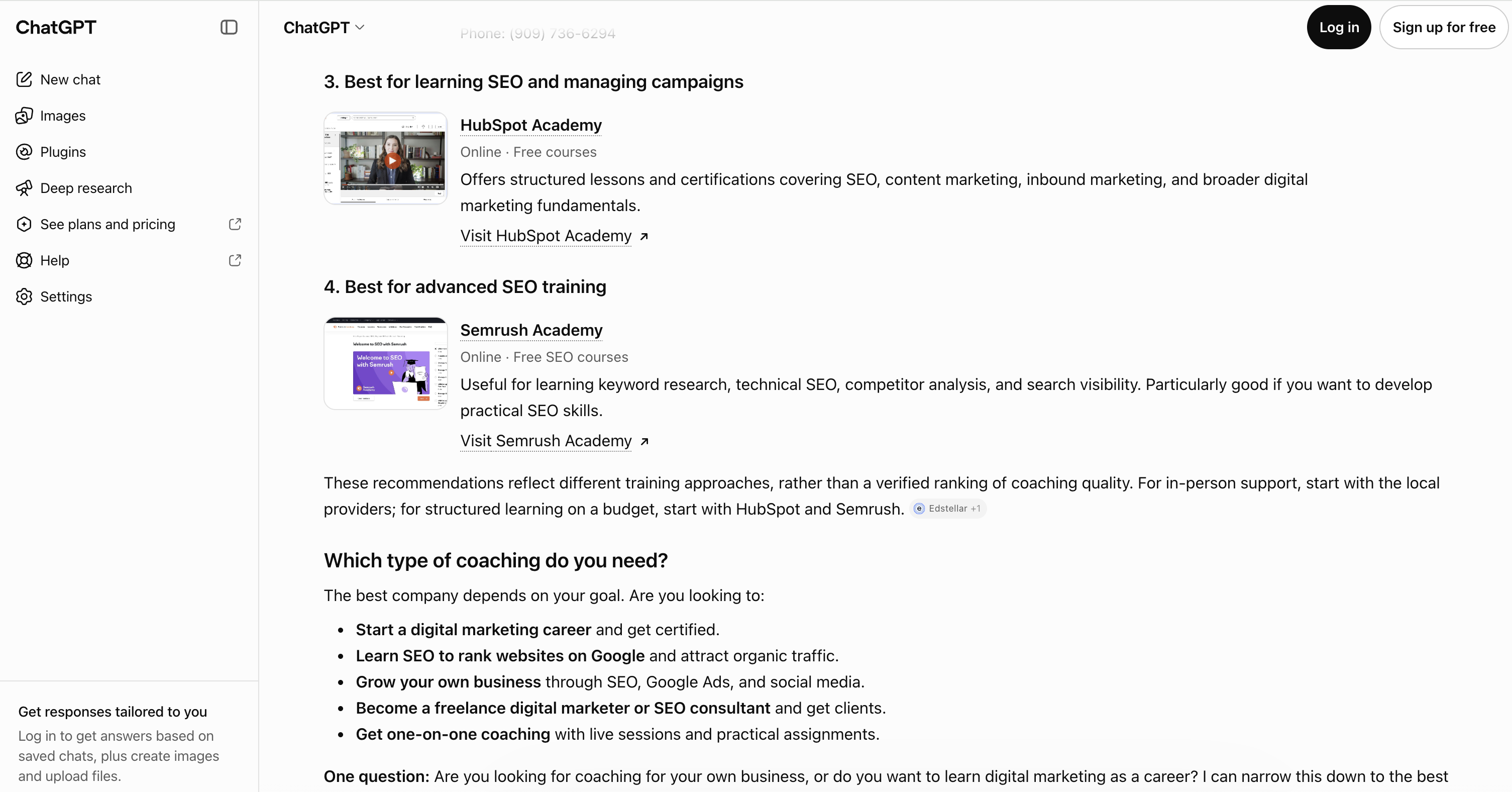
1. ChatGPT wasn't just listing companies. It was categorizing them.
Some businesses were introduced with descriptions such as:
-
Best for personalized marketing guidance
-
Best for SEO and broader digital marketing support
-
Best for learning SEO and managing campaigns
-
Best for advanced SEO training
Think about those descriptions for a moment. They help someone understand which company might be appropriate for their particular situation.
Now look at your own website.
- Does it clearly explain what your business specializes in?
- Does it explain who your services are for?
For example, a photographer might specialize in actor headshots, corporate headshots, commercial photography, or weddings.
A contractor might focus on commercial roof repairs, residential remodeling, or emergency plumbing.
Those distinctions are worth communicating clearly.
Try this: Open your homepage and ask yourself whether someone unfamiliar with your business could identify your primary services, ideal customers, and service area within a few seconds.
If not, start there.
2. Location appeared to influence the recommendations
When I searched in guest mode, ChatGPT recommended businesses around Rancho Cucamonga.
That made me think about how important geographic information can be for businesses serving specific communities.
For example, imagine someone searching for: "Recommend a commercial photographer in Long Beach." Or: "Find a business coach who works with restaurant owners in Los Angeles."
If your business serves those areas, is that information clearly stated on your website?
Don't assume AI platforms will automatically understand every city you serve.
Make your location and service areas easy to find. For businesses eligible for a Google Business Profile, keep your business information accurate and up to date.
Also review your business listings and profiles on other relevant websites.
Try this: Search for your primary service with your city name in ChatGPT, Google, and another AI search platform. Record which businesses appear and how they're described.
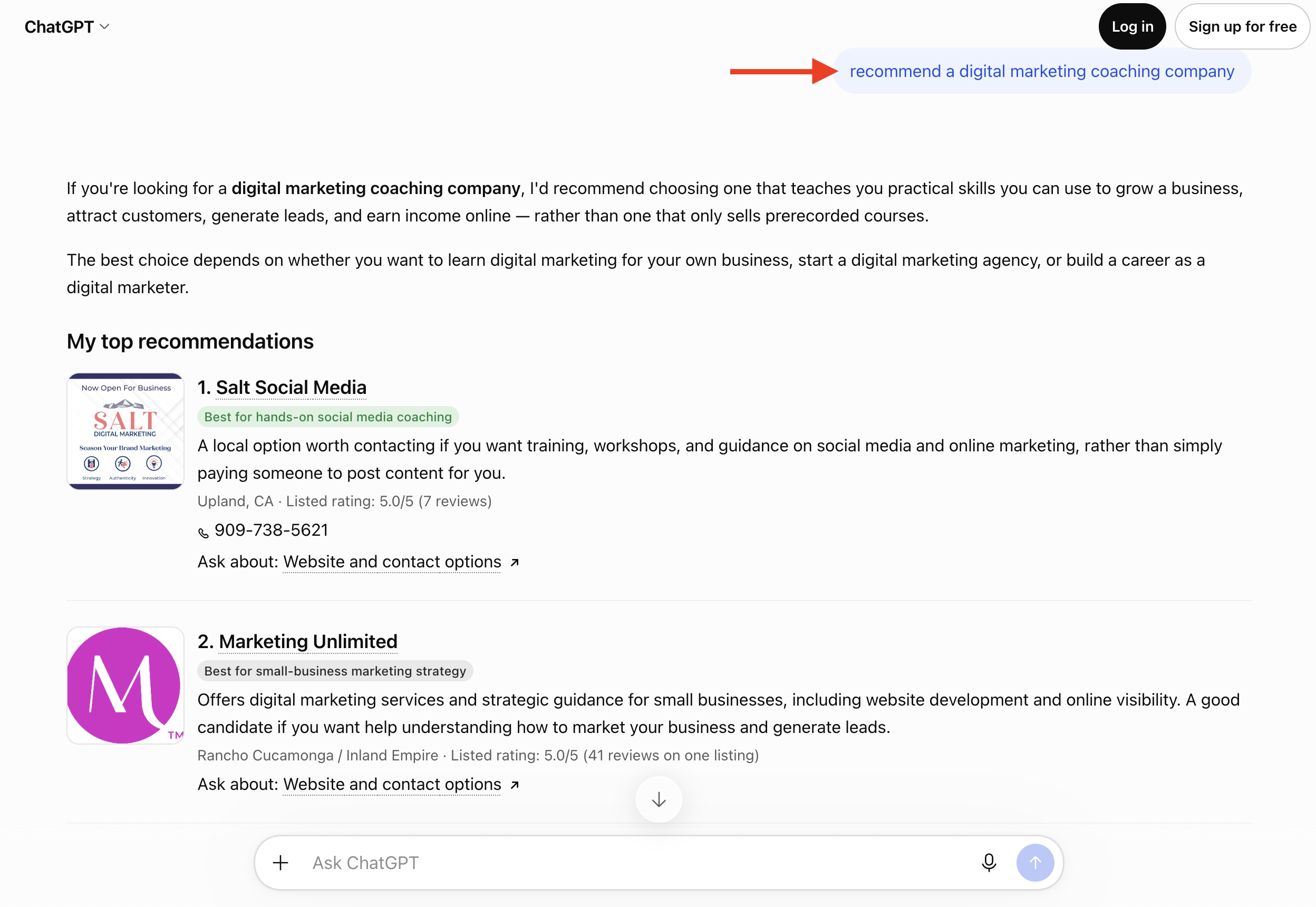
When I repeated the search in guest mode, ChatGPT recommended different companies, including businesses near Rancho Cucamonga.
3. The follow-up questions gave me content ideas
This was probably the most interesting part of my experiment.
ChatGPT didn't stop at recommending companies. It also asked questions to help narrow the results.
For digital marketing coaching, those questions included:
What do you want to accomplish?
-
Grow an existing business
-
Learn digital marketing for a career
-
Start a marketing agency
-
Generate income through online marketing
What type of coaching do you prefer?
-
Individual coaching
-
Live group coaching
-
Online training
-
In-person coaching
What is your budget?
Those questions reflect different customer needs.
And they gave me an idea.
What if your website already answered the questions potential customers are likely to ask before choosing a business like yours?
For example, a digital marketing coaching company could publish helpful content explaining:
-
How much does digital marketing coaching cost?
-
What's the difference between individual and group coaching?
-
Can a small business owner learn SEO without hiring an agency?
-
What should a business owner expect from ongoing digital marketing coaching?
-
How do you choose an SEO coach for your business?
A roofing company, accountant, or photographer could do the same with questions specific to their services.
The goal isn't to copy every question ChatGPT generates.
It's to understand what customers want to know and provide useful answers based on your experience.
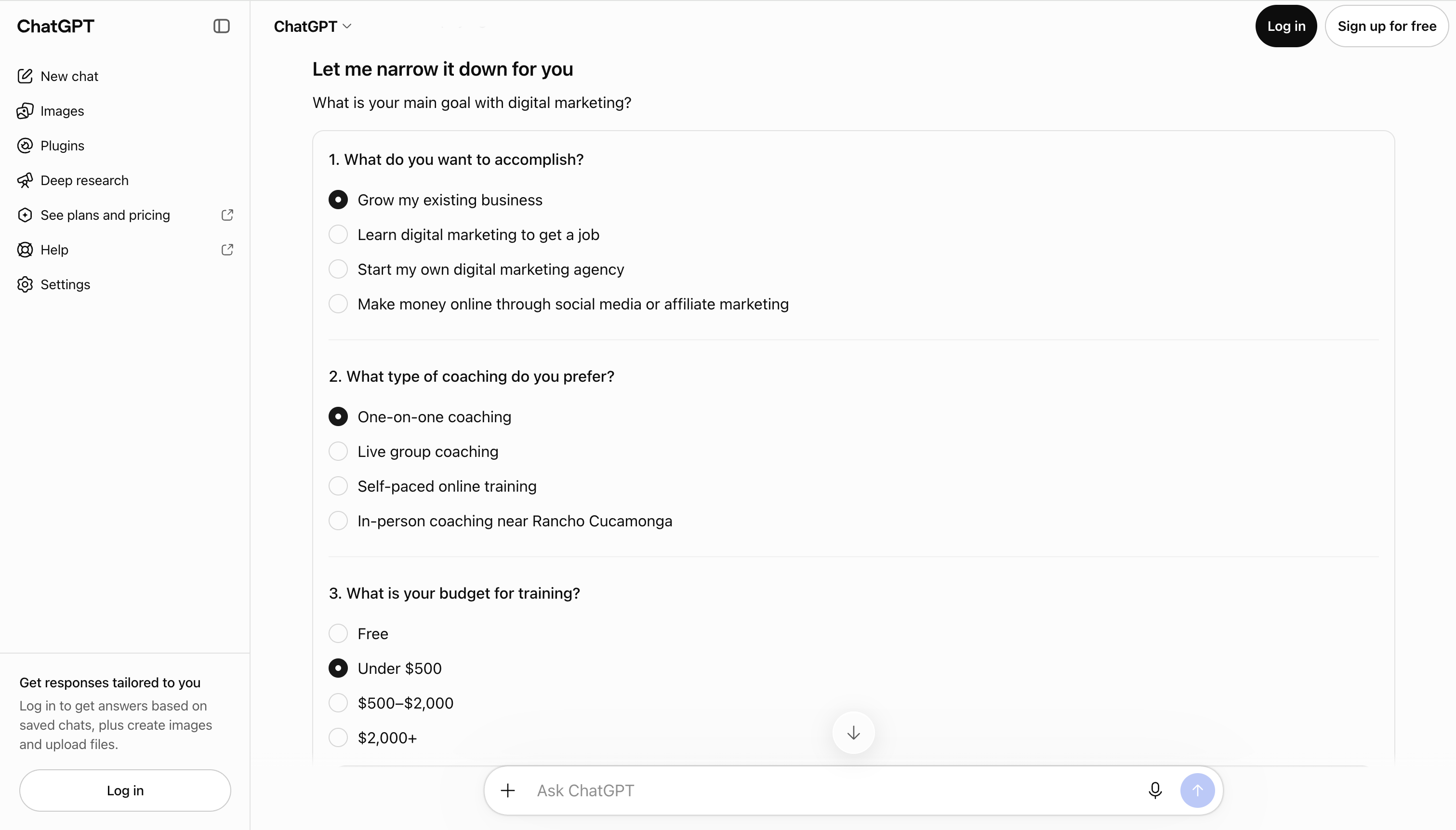
ChatGPT categorized recommendations by specialties and customer needs, rather than simply listing business names.
4. Explain how your services work, not just what you offer
Another detail caught my attention. ChatGPT didn't simply name the companies. It explained the type of assistance each one provided.
Some descriptions mentioned personalized support, SEO, website development, marketing strategy, or structured training.
That's a reminder to look at your service pages. For example, simply saying "We offer SEO services" doesn't tell a potential customer very much.
A more informative description might explain that your SEO coaching includes reviewing a company's website, identifying relevant search terms, monitoring keyword rankings, reviewing competitors, and helping the business owner understand which improvements to make.
Now a potential customer has a better idea of what they're paying for.
Try this: Visit your main service page and answer these four questions:
-
Who is this service for?
-
What problem does it help solve?
-
What does the customer actually receive?
-
What should someone do to get started?
Those answers belong on your website.
ChatGPT asked questions about customer goals, preferred coaching formats, and budgets. These questions inspired ideas for website content.
5. Give AI search platforms accurate information to work with
Your website is only part of your online presence.
During my experiment, some recommendations included company locations, reviews, phone numbers, and website links.
This is a reminder that your business information should be consistent wherever potential customers might encounter you.
Review your website, business profiles, industry directories, and professional listings. Make sure your services, contact details, business name, and location information are accurate.
Customer reviews, relevant third-party mentions, and examples of completed work can also give prospective customers more information to evaluate.
Don't create fake reviews or manufacture mentions to influence AI recommendations. And remember that AI systems can make mistakes. Being recommended isn't proof that a business is the best provider.
6. Make sure search systems can access your website
Before publishing dozens of new articles, check that search engines can actually access your important pages.
OpenAI identifies OAI-SearchBot as the crawler used for ChatGPT search visibility.
Google also recommends making website content accessible, maintaining a clear website structure, and publishing helpful information.
You can start by checking:
-
Is your website accessible to search crawlers?
-
Are your important service pages indexable?
-
Does your website have a clear navigation structure?
-
Can visitors easily find your services and contact information?
-
Are you publishing original information that helps customers make decisions?
You don't need to rebuild your entire website around AI.
Good SEO, accurate business information, and helpful content still have a place in AI search visibility.
7. Test your business in AI search, then make improvements
Here's an exercise you can complete this week. Open ChatGPT in a guest session or an account without previous conversations about your business.
Search for the type of company you operate. For example: "Recommend a commercial photographer in Los Angeles."
Then try a more specific request: "Recommend a commercial photographer in Los Angeles who specializes in corporate headshots."
Pay attention to the results.
- Which businesses appear?
- How does ChatGPT describe them?
- Does it mention specialties, locations, prices, or customer reviews?
- Does it ask questions to narrow the recommendations?
Now compare those details with the information available on your own website.
Repeat the test on another day and with another AI platform. One response isn't enough to measure your visibility.
You might find opportunities to improve your service descriptions, answer missing customer questions, update your business profiles, or publish a helpful article.
Start with one service, not your entire website
You don't need to write 30 blog posts this week.
- Choose one service you want more customers to find.
- Identify five questions someone might ask before purchasing that service.
- Answer those questions clearly on your service page or in a related article.
- Include real examples, useful details, and information that comes from your own experience.
Then test your visibility again over time. AI recommendations can change, and no article can guarantee a placement. But the work you put into explaining your services and answering customer questions can also improve your website for people arriving through traditional search.
Here's my question for you:
If someone asked ChatGPT to recommend a company that provides exactly what you offer, would your website give it enough accurate information to understand why your business might be a relevant choice?
Try the experiment and see what you find.
Free AI Search Visibility Tracker
Want to see if ChatGPT, Claude, Gemini, or Perplexity recommends your business?
I've created a free spreadsheet to help you test your business's visibility across these AI platforms and see which competitors are being recommended.
The spreadsheet includes suggested search questions for realtors, insurance agencies, contractors, restaurants, photographers, and other businesses.
You can record your results, compare recommendations, and check again later to see if anything changes.
[Get Your Free AI Search Visibility Tracker]
The spreadsheet opens in Google Sheets. Click File > Make a copy to save your own editable version. No signup required.