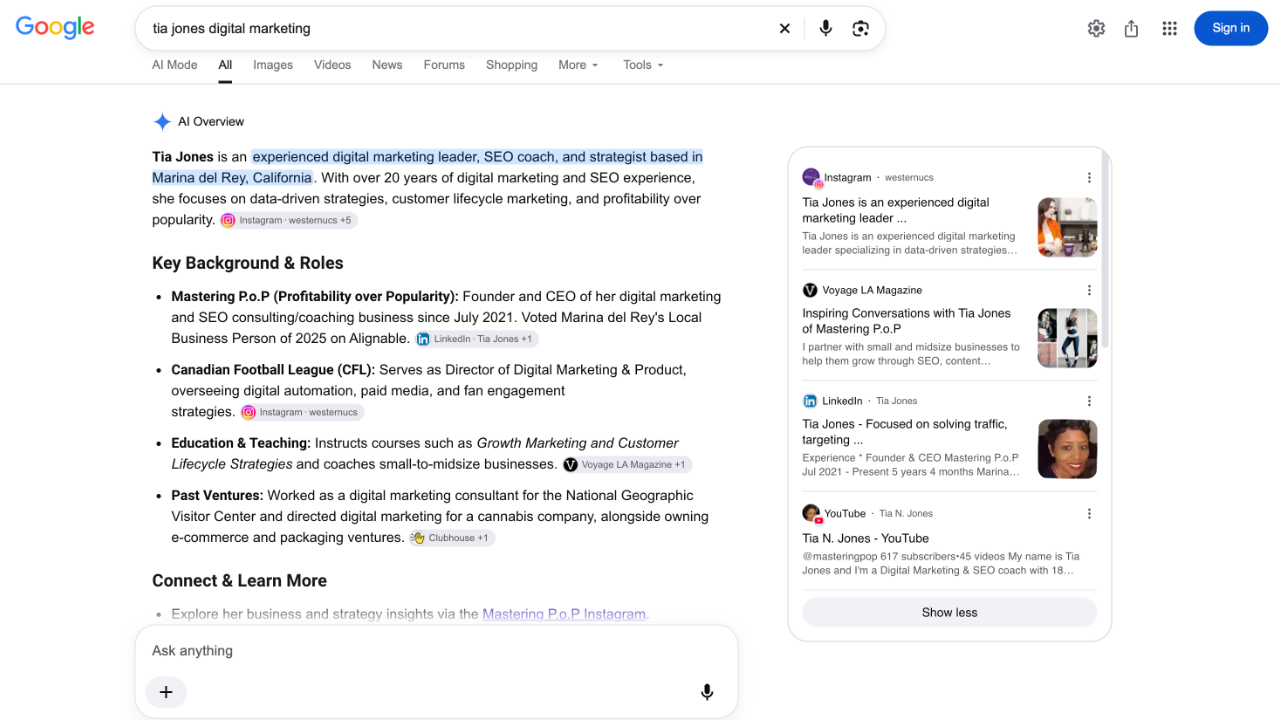
Have you ever searched for your name or business on Google and been surprised by how much information appeared?
Maybe Google displayed your professional background, services, location, social media profiles, or even an AI-generated summary describing who you are and what you do. But where does all that information come from?
Your website is one source, but Google can also find information about your business through online publications, professional profiles, customer reviews, business directories, and publicly accessible discussions.
Here's something I think more business owners should understand:
Google knowing your business exists is not the same as Google showing your business to people searching for the services you provide.
And just because something is published online doesn't mean Google has indexed it or will use it in an AI-generated answer.
Google Doesn't Rely Exclusively on Your Website
When someone searches for your business, Google may display information from several different websites.
Your own website might appear alongside your LinkedIn profile, business listings, interviews, customer reviews, and other online mentions.
Google's AI Overviews can also summarize information related to a search and provide links to supporting sources. But there are three different things happening here that are easy to confuse.
- Crawling: Google discovers and accesses webpages.
- Indexing: Google processes information from a page and may include it in its search index.
- Ranking: Google determines which pages to display for a particular search and in what order.
AI-generated answers introduce another consideration. Google may use relevant information from multiple sources when generating an AI Overview, but being indexed doesn't guarantee that a page will be cited.
This is why publishing content on a website or community platform doesn't automatically translate into Google visibility.
Six Places Google May Find Information About Your Business
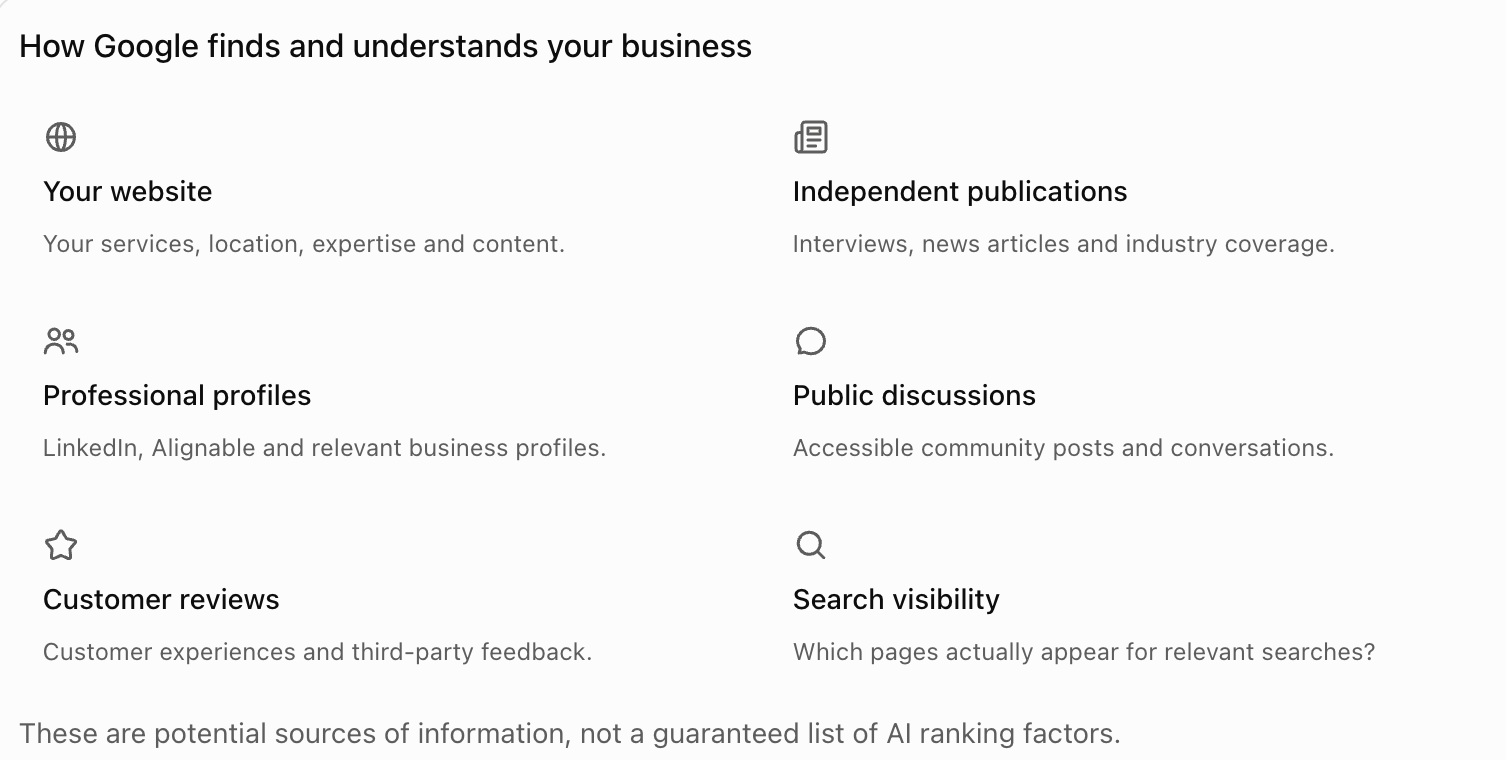
Your online presence extends beyond your website. Here are six types of sources worth paying attention to.
1. Your Website
Your website gives you direct control over how you describe your business.
It should clearly explain:
-
What products or services you offer
-
Who your business serves
-
Where you're located or which areas you serve
-
Your experience and qualifications
-
How someone can contact you or take the next step
Google can use information from your website to understand its content and relevance to different searches.
However, a website filled with vague statements about being the best or offering exceptional service may not provide visitors with enough information to evaluate the business.
Clear, specific information is more helpful than repeating keywords throughout a page.
2. Independent Publications and Interviews
Online magazines, industry publications, local news websites, and interviews can introduce your business to people who may not already know you.
They can also provide independent information about your professional experience, business activities, and expertise.
For example, I recently searched Google for my name along with digital marketing and SEO.
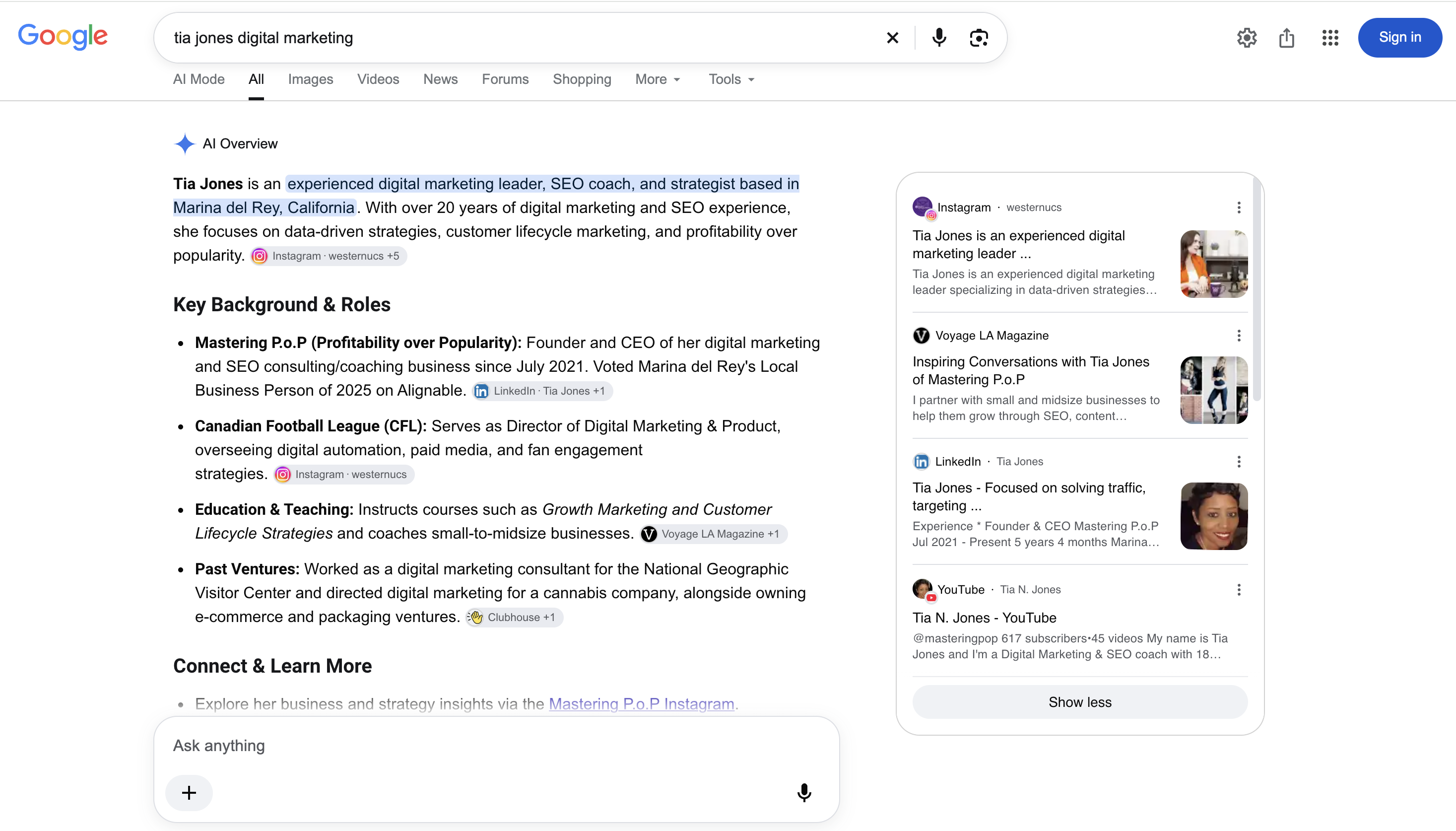
Google generated an AI Overview describing my professional background and identifying me as the founder of Mastering P.o.P. One of the sources it cited was an interview published by Voyage LA Magazine.
That caught my attention because Google wasn't relying exclusively on my own website to describe me. It was also referencing an independent publication.
A relevant mention from a respected publication, local organization, or industry partner may provide more meaningful exposure than appearing in dozens of unrelated, low-quality directories.
That doesn't mean every publication mention improves your rankings or guarantees an AI citation. But it demonstrates why your online presence shouldn't begin and end with your website.
3. Professional Profiles and Business Listings
Professional platforms and business directories provide additional places where people can find information about your business.
Examples include LinkedIn, Alignable, Google Business Profiles, and relevant industry directories.
These profiles may contain your business description, services, location, website address, and professional background.
For local businesses, accurate information can help customers identify the correct company and find ways to contact it. But there's an important distinction.
Having a business profile appear in Google doesn't mean every post, article, or discussion published on that platform is indexed.
A business profile and an individual discussion page are separate webpages. Google may index one without indexing the other. That's particularly interesting when we consider online communities.
4. Public Discussions and Online Communities
Many business owners spend time participating in online groups, answering questions, and sharing their expertise.
Platforms such as Reddit and Alignable provide opportunities to connect with other people and businesses. But how much of that activity actually appears in Google search results?
That depends on the platform, the accessibility of individual pages, and Google's indexing decisions.
For example, I participate in Alignable communities and have a business profile on the platform.
When I searched Google for my name and business, Alignable pages appeared in the results.
However, that doesn't establish that my individual group discussions are being indexed or appearing for relevant searches. And it certainly doesn't prove those discussions are being used in AI-generated answers.
This is an important distinction because business owners may assume that every public post contributes to their Google visibility.
Publishing content, getting it indexed, ranking for relevant searches, and being cited in an AI-generated answer are four different outcomes.
Online communities can still be valuable for networking, referrals, and professional relationships, even when individual discussions receive little search visibility.
5. Customer Reviews
Customer reviews provide another source of information about businesses. People may mention specific services, products, experiences, and locations in their reviews.
For local businesses, Google reviews can appear prominently alongside business information in Google Search and Maps. Reviews can also help potential customers decide if a business is worth contacting.
However, reviews shouldn't be treated simply as another way to influence AI search. Their value also comes from helping real people evaluate a business.
A company with clear service information and authentic customer feedback may give prospective customers more confidence than one with little information beyond its own marketing claims.
6. Industry Organizations, Business Partners, and Other Relevant Websites
Your business may also be mentioned on websites belonging to organizations you work with.
These might include local business associations, professional organizations, educational institutions, event organizers, referral partners, and industry websites.
For example, a business owner who participates in a professional workshop might be featured on the hosting organization's website.
A business partnership might result in a public member profile, an interview, or a resource page mentioning the company. These mentions can introduce your business to relevant audiences beyond your own website. But quality and relevance deserve more attention than quantity.
A meaningful mention on a website connected to your industry or community may offer more value to potential customers than dozens of listings on websites nobody uses.
Again, there is no guarantee that Google will rank or cite those pages.
Showing Up for Your Name Isn't the Same as Showing Up for Your Services
This is one of the most interesting things I noticed when reviewing my own Google results.
I searched several variations of my name, including:
-
Tia Jones
-
Tia Jones digital marketing
-
Tia Jones digital marketing SEO
Google displayed results from LinkedIn, YouTube, Instagram, Alignable, Voyage LA Magazine, and Mastering P.o.P.
Some searches also generated an AI Overview describing my professional background. That's useful information, but these are primarily branded searches.
What Is a Branded Search?
A branded search includes a person's name, company name, or recognizable brand.
For example: "Tia Jones digital marketing SEO"
Someone entering that search already knows my name.
They may be researching my background, checking my experience, or trying to find my business.
What Is a Nonbranded Search?
A nonbranded search describes a product, service, or problem without naming a specific business.
Examples include:
-
SEO consultant near me
-
Digital marketing services for small businesses
-
Local SEO consultant
-
SEO consultant Marina del Rey
-
Digital marketing Marina del Rey
These searches can introduce businesses to potential customers who haven't heard of them before. And that's where the distinction becomes important.
A business can have a strong branded presence in Google while having limited visibility for the services it actually sells.
Google might know exactly who you are when someone searches your name. But that doesn't mean your business will appear when someone searches for a service you provide.
Both types of visibility are worth measuring, but they tell different stories.
Appearing in an AI Overview about your business is encouraging, but it doesn't tell you how often potential customers are finding you through searches related to your services. That's why it's important to look beyond your business name and pay attention to the searches that actually bring people to your website.

Does Posting More Content Help Google Find Your Business?
Not necessarily.
Publishing more content creates additional pages that Google may encounter, but those pages still need to be accessible and eligible for indexing.
Even indexed pages aren't guaranteed to rank prominently. This applies to blog articles, business profiles, community discussions, and other online content.
Before spending hours publishing across different platforms, it's worth asking:
- Is the content publicly accessible?
- Can Google find and index the individual page?
- Does the page appear for relevant searches?
And is the content reaching people who might actually be interested in the business?
For websites you own, Google Search Console provides information about search queries, impressions, clicks, and indexing.
For content published on third-party platforms, the available information may be more limited.
You can search Google for a distinctive phrase from a public post or use the site: search operator to look for pages from a particular domain.
However, these searches are only diagnostic clues. They aren't a complete or definitive test of Google's index.
How to Check What Google Knows About Your Business
You don't need expensive software to begin investigating your Google presence.
Here are five things you can do.
Step 1: Search Your Business Name
- Enter your business name into Google.
- Look beyond your own website.
- Which other websites appear?
Do you see professional profiles, interviews, business directories, reviews, or other mentions?
Pay attention to the information those pages display about your business.
Step 2: Search Your Name and Profession
If you're the public face of your business, search your name along with your profession or services.
For example: "Your Name SEO Consultant"
Look at how Google describes your professional background and which websites appear.
If an AI Overview is displayed, examine its supporting sources rather than relying only on the generated summary.
Step 3: Search for Your Services Without Your Business Name
Now remove your name and business name from the search. Search for the services you offer, along with your location if you serve a particular geographic area.
Compare those results with your branded searches.
- Are you appearing alongside competitors?
- Do relevant service pages from your website appear?
This is a useful way to investigate how visible your business may be to people who don't already know you. Remember that individual search results can vary by location, device, and other factors.
Step 4: Review Your Third-Party Mentions
Look for websites that mention your business. Consider the source.
- Is it relevant to your industry?
- Does it reach people who may be interested in your services?
- Does it accurately describe what you do?
A relevant mention can be useful even when it doesn't generate a direct Google ranking improvement.
It might introduce your business to new people, support a professional relationship, or send interested visitors to your website.
Step 5: Review Your Search Console Data
If you have Google Search Console connected to your website, review the search queries generating impressions and clicks.
Look at the difference between searches containing your business name and searches related to your services.
- Are people finding your website because they already know your business?
- Or are they finding it while researching products, services, and solutions?
This information can help you identify opportunities to improve your website content.
Getting Found Is Only Part of the Customer Journey
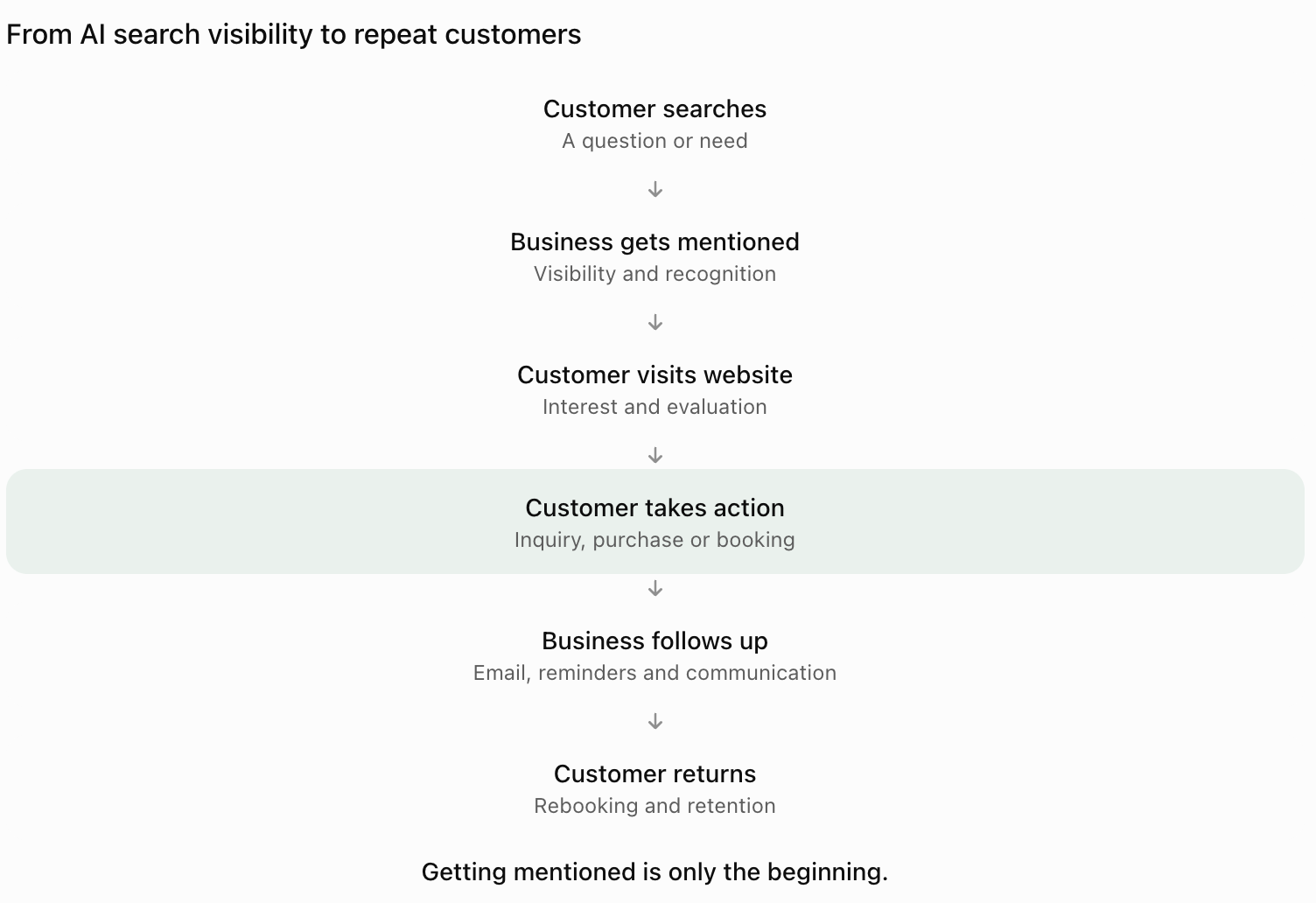
There's another question I think deserves more attention in conversations about SEO and AI search visibility.
What happens after someone learns about your business?
Let's say your business appears in a Google AI Overview or gets mentioned in an answer from ChatGPT.
Someone becomes interested. They might visit your website, search your business name, read reviews, call you, or compare you with another company.
Now what?
- If they visit your website, can they immediately understand your services?
- Is it easy to request information, contact you, or book an appointment?
- And what happens if they're interested but not ready to buy?
- Do you have a way to stay in touch?
A business could improve its visibility in Google and AI search while still struggling to generate customers because the next steps aren't clear.
That's why I think the conversation needs to extend beyond getting mentioned.
Visibility creates an opportunity. Your website, customer experience, and follow-up process help determine what happens with that opportunity.
And for businesses that depend on repeat customers, the journey doesn't end with the first appointment or purchase.
Customer communication, reminders, and follow-up can also support retention and repeat business.
Your Business May Be Visible, But Is It Being Found by the Right People?
Google may know your business name, location, professional background, and services.
It may find information about you through your website, publications, professional profiles, reviews, and other relevant sources.
But that doesn't automatically mean your business is appearing when potential customers search for what you offer.
It also doesn't mean those visitors will become customers. That's why I encourage business owners to look at the bigger picture.
Pay attention to where information about your business appears online.
Compare branded and non-branded searches. Review the search queries bringing people to your website.
And think about the experience someone has after finding you.
Here's something to try today:
Search Google for your business name. Then search for your main service without including your business name. Compare what appears.
You might be surprised by how differently Google presents your business in those two searches.