
I recently came across a conversation online from someone working with roofing companies who was frustrated. He wasn't frustrated because he didn't care about his clients. Quite the opposite.
He was building websites, working on Google Business Profiles, creating service and city pages, helping businesses collect reviews, managing Google Ads and trying to figure out which backlinks were actually worth pursuing.
But the part of the conversation that caught my attention wasn't really about SEO. It was why he got into helping contractors in the first place. He had watched small trades businesses spend a lot of money with people who gave them mediocre websites, built questionable backlinks, collected their money and disappeared.
I've seen versions of this story for more than 20 years. And it isn't just roofers. Plumbers, electricians, HVAC companies, flooring companies, landscapers, painters, remodelers and other contractors deal with the same problem.
They didn't start their businesses because they wanted to become digital marketers. Yet somewhere along the way, that's exactly what we've started expecting them to be.
Running the Business Is Already a Full-Time Job
Think about what the average contractor is already responsible for. There are estimates to prepare, jobs to schedule, employees and subcontractors to manage, materials to purchase, customers to call back, invoices to collect, licenses and insurance to maintain and problems that inevitably show up in the middle of a job.
- Then we tell them they need SEO.
- They need more Google reviews.
- They need to optimize their Google Business Profile.
- They need individual service pages.
- They should be creating content.
- They need email marketing.
- They should be texting customers.
- They need to track leads and conversions.
- They should be using AI.
- They need Google Ads.
- They need social media.
- And their website needs to convert.
That's a lot to put on someone who is also trying to run a business. The problem isn't that contractors can't understand marketing.
It's that they shouldn't have to become marketing experts just to figure out if the money they're spending is actually helping their business grow.
Contractors Are Spending Money on Digital Marketing
A lot of small businesses aren't ignoring marketing. They're already paying for it. The bigger problem is that they're often buying disconnected pieces.
- One company built the website.
- Someone else manages Google Ads.
- Another person posts on social media.
- An SEO company sends a report every month.
- Someone occasionally sends an email.
The office asks customers for Google reviews when someone remembers. There may be hundreds or thousands of previous customers sitting in a database that nobody markets to.
Nobody is quite sure if Google Analytics is tracking everything correctly. The owner knows the phone rings, but can't always tell you what caused the person to call. That's not really a marketing system. It's a collection of marketing activities. There's a difference.
Keyword Rankings Are Nice. Revenue Is Way Better.
This is one of the things I appreciated about the roofing discussion that originally caught my attention. The conversation started with Google Maps rankings and backlinks.
Eventually, someone brought the discussion back to something much more important:
- Calls.
- Forms.
- Quotes.
- Booked jobs.
- Revenue.
That's the conversation more contractors should be having about their marketing. If your roofing company ranks #1 for a phrase almost nobody searches, how much did that ranking actually help your business? If you're getting hundreds of website visitors but nobody requests an estimate, something is wrong. If you're spending thousands on Google Ads but nobody knows which calls became paying customers, we're missing information. And if 1,000 previous customers have already trusted your company but you never communicate with them again, you're ignoring an audience you already paid to acquire.
- SEO rankings are a measurement.
- Traffic is a measurement.
- Google Maps visibility is a measurement.
None of those automatically equals revenue.
Your Website Is Only One Piece of the Puzzle
I've spent a large part of my digital marketing and SEO career working with websites and search, so I absolutely believe a company's website matters. But I don't believe every business problem should be answered with:
"You need a new website."
Sometimes you don't.
- Maybe your website is fine and not enough people can find it.
- Maybe people find it but don't call.
- Maybe you're getting leads but nobody follows up quickly enough.
- Maybe your Google Business Profile needs work.
- Maybe you have years of previous customers who haven't heard from your business since their last job.
- Maybe you don't have a consistent process for getting reviews.
- Maybe you're already paying for software that includes marketing features nobody on your team knows how to use.
- Maybe your analytics and conversion tracking aren't configured properly, so you're making marketing decisions without enough information.
Before telling a business owner to spend more money, I want to know what's already there.
Contractors & Service Businesses Already Have Marketing Content
One of the biggest missed opportunities I see with contractors is content. Not because contractors don't have content. They have tons of it. They just don't necessarily think of it as marketing.
- Every completed job can tell a story.
- A roof replacement in Pasadena is content.
- Before and after photos from a flooring installation are content.
- A complicated plumbing repair can become content.
- A customer explaining why she chose your HVAC company is content.
- A question homeowners repeatedly ask during estimates can become an article.
- A completed project in a city you're trying to grow in can become a project page.
- Your relationships with manufacturers, suppliers and other local businesses can help establish credibility.
- Years of completed work represent something a brand new competitor can't manufacture overnight:
- Actual experience.
Instead of constantly asking, "What should we post?", contractors should start documenting what they're already doing.
That's where some of the best marketing material is hiding.
Stop Chasing Marketing Tactics Without Knowing Why
This is also why I'm cautious when someone tells a small business owner they absolutely need one specific marketing tactic.
- "You need backlinks."
- "You need to post every day."
- "You need TikTok."
- "You need Google Ads."
- "You need AI."
- "You need more blog posts."
Maybe. But maybe not.
I want to know the business first.
- What services make you the most money?
- Which jobs do you actually want more of?
- Which services aren't worth advertising?
- Where do your best customers come from?
- Which cities generate profitable jobs?
- How many leads do you currently receive?
- How quickly does someone respond to them?
- How many estimates become customers?
- How many previous customers do you have?
- Are you asking those customers for reviews?
- Do you have their email addresses?
- Do you have permission to communicate with them by text?
- Are people visiting your website and leaving without contacting you?
- Which marketing channels are actually producing paying customers?
Those answers tell us much more about what should happen next than blindly adding another marketing tool.
A Few Things Contractors and Service Businesses May Be Missing
If your business serves customers beyond the city where you're located, simply adding those cities to your Google Business Profile doesn't mean you'll automatically show up in Google Maps there.
Google pays attention to how close a business is to the person searching. That means a contractor located in one city may have a harder time appearing in the top Google Maps results when someone searches from another city.
That doesn't mean you should ignore those areas.
Here are a few things you can be doing:
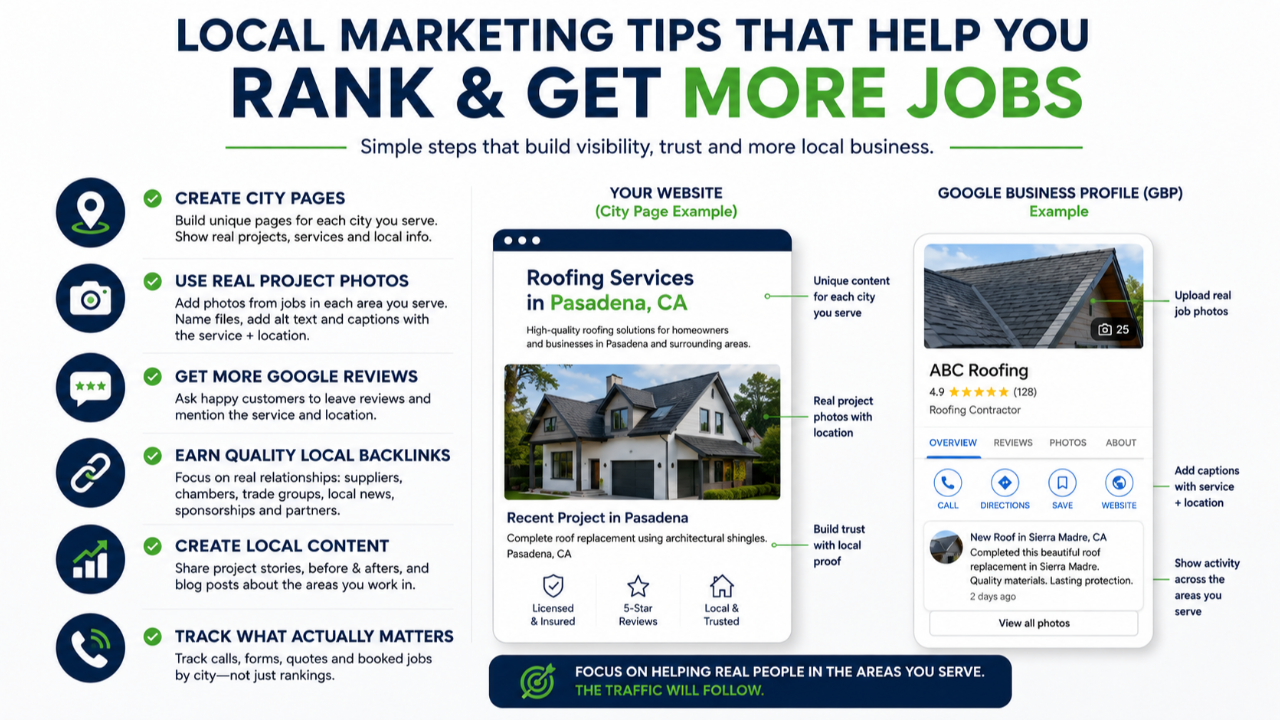
Create pages for the cities you actually serve. If you're a roofer in one city but regularly work in several surrounding communities, your website can have useful pages explaining the services you provide in those areas. Don't create 20 nearly identical pages and swap out the city name. Show actual work, services and customer experiences from that location. When adding project photos, give the images descriptive file names and alt text that accurately describe the job and location, such as “roof replacement in Pasadena.” You can also add captions when they’re useful to the visitor. When uploading real job photos to your Google Business Profile, add a short description or caption when Google gives you that option, explaining what the project was and where it was completed.
Turn completed jobs into local content. Finished a major project in a city you want more business from? Document it. Turn the project into a helpful blog post explaining the problem, what you did, the service provided, and the area you served. Add real project photos and optimize them with descriptive file names, alt text, and captions where appropriate. Then reuse that same project across your marketing. Turn it into social media posts, a Google Business Profile post, an email to customers, and even a short video if you have enough photos or footage. One completed job can give you multiple pieces of useful content while showing Google and potential customers the services you provide and the communities you actually serve.
Ask for Google reviews consistently. Don't wait until you suddenly need more reviews. Build asking into your normal customer follow-up process. Send a review request after the job is completed, and if the customer doesn't leave one, follow up again later by email or text. If your business uses push notifications, that can be another way to follow up with customers who have opted in. You can even automate these reminders so your team doesn't have to remember to send every request manually. When customers naturally mention the service you performed or the city where the work took place, that can provide additional context about the services and areas your business serves.
Look beyond Google Maps. You may not always be able to make a business located in City A dominate Google Maps in City B, especially when competitors are physically located closer to the person searching. That's one reason you're creating helpful, locally focused content on your website. Your service pages, city pages, project stories, blog posts, customer questions, photos, and other useful content can give your business opportunities to appear in Google's regular organic search results for the surrounding cities you serve. Instead of relying entirely on Google Maps, you're building another way for local customers to discover your business.
Build local relationships, not random backlinks. A backlink is simply another website linking to yours. Instead of buying dozens of questionable links, build relationships with real businesses and organizations in the communities you serve. Start with suppliers, manufacturers, chambers of commerce, trade associations, community organizations, sponsorship opportunities, and complementary businesses that serve similar customers. You can also use business networking platforms such as Alignable, local chamber directories, industry associations, and local business groups to find potential partners. A roofer might connect with a realtor, insurance agent, property manager, solar company, or general contractor, for example. These relationships can lead to referrals, joint content, local events, website mentions, and legitimate backlinks. Don't approach another business just asking for a link. Look for ways you can actually help each other.
Pay attention to where the money is actually coming from. If you're consistently getting calls, estimates and paying customers from a nearby city, track it. That information can influence where you advertise, what content you create and where you focus your marketing next.
And if a large percentage of your business eventually comes from another market, that becomes a business decision, not just an SEO decision. At some point, a legitimate second location may make more sense than constantly trying to force your original location to dominate Google Maps somewhere else.
The goal isn't to do every marketing tactic you hear about.
It's to figure out which ones make sense for where your business is trying to grow.
Marketing Shouldn't Be a Mystery to the Business Owner
This is a big reason I created Mastering P.O.P. I've worked in digital marketing since 2006, and I've watched marketing become increasingly complicated.
- SEO has changed dramatically.
- Local search became its own discipline.
- Advertising platforms became more sophisticated.
- Email automation became accessible to small businesses.
- Text marketing grew.
Software companies started bundling marketing tools into products businesses were already using. Now artificial intelligence is changing how people search, how businesses create content and how customers discover companies.
A contractor shouldn't have to become an expert in all of that. But I do believe business owners should understand what is happening with their marketing.
- You should know what you're paying for.
- You should have access to your own accounts.
- You should know what tools your company is paying for.
- You should know where your leads are coming from.
- You should know which marketing is producing business.
- You should understand what the person or company managing your marketing is actually doing.
And somebody should be able to explain it without burying you in marketing terminology.
Sometimes You Need Advice. Sometimes You Need Help Doing It.
This is where I think small businesses need different options. Some business owners have the staff, time or ability to implement their own marketing. They don't necessarily need someone doing everything for them.
They need someone experienced looking at their specific business and saying:
- Here's what I see.
- Here's where you're losing opportunities.
- Here's what I'd work on next.
- Here's how I would approach it.
- And here's how you can actually do it.
Other established businesses don't have the time or internal resources for that. They don't need another list of things they should be doing.
They need help doing them. That's why Mastering P.O.P. offers two different levels of support.
Hands-On Marketing for Established Businesses: $2,500
Our $2,500 hands-on option is for established businesses that want us directly involved in improving their marketing.
We start by looking at what the business already has rather than automatically replacing everything.
That can include reviewing your website, Google Business Profile, local SEO, analytics and tracking, lead generation, customer database, email marketing, text marketing, content, existing software and other marketing channels.
Then we identify what's missing, what's being underused and where opportunities are being lost.
From there, we work hands-on with the business to implement the agreed-upon priorities.
That could mean setting up or fixing analytics and conversion tracking, improving local search visibility, creating or optimizing pages, developing email campaigns, building customer follow-up processes, improving review generation, finding opportunities within an existing customer database, developing content from real business activity or helping connect marketing tools that aren't currently working together.
The work will look different from one business to another because the businesses are different. The goal isn't to sell you every marketing service available. It's to figure out what your business actually needs and help put it into place.
Mastering P.O.P. Business Guidance: $249 Per Month
Not every business needs hands-on implementation.
For $249 per month, we work with you around your specific business and help you determine what to do, how to approach it and where to focus next.
- Bring us your website.
- Your Google Business Profile.
- Your marketing campaigns.
- Your ideas.
- Your analytics.
- Your email marketing.
- Your SEO questions.
- Your AI questions.
- Your software.
- Your lead generation problems.
- Your latest marketing proposal.
Even the service someone is trying to sell you that you're not sure you actually need. We'll look at it with you and help you make sense of it. You or your team handle the implementation. We help you figure out the strategy and next moves.
Because a roofer doesn't need to become an SEO expert. A plumber doesn't need to become an email marketer. An electrician shouldn't have to spend nights trying to understand Google Analytics. And a business owner shouldn't have to blindly trust every person trying to sell them another marketing service.
You should understand enough about your marketing to make informed decisions about your business. And when you need help figuring out what comes next, you should have somewhere to turn.