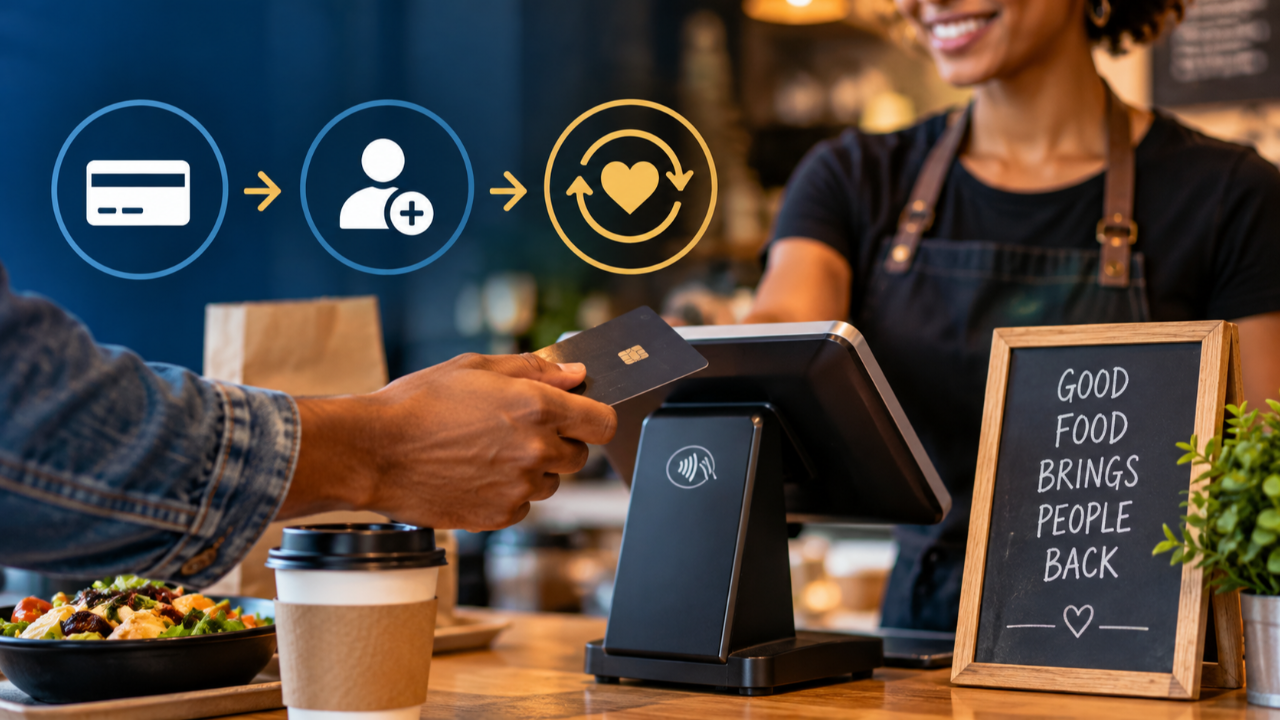
A customer walks into your restaurant, coffee shop, bakery, café or food truck.
They place an order, pay, get their food and leave. Yay, you made the sale, right? But did you capture the customer? That's a different question. If that customer doesn't come back on their own, do you have any way to reach them again?
- Do you have their email address?
- Their phone number?
- Are they part of your loyalty or rewards program?
- Can you send them an offer next week?
- Can you tell them about a new menu item, an upcoming event or a catering special?
Or did you simply process their payment and watch them walk out the door?
For a lot of food businesses, the transaction is where the relationship ends. And that's a problem.
If 200 Customers Bought From You Last Week, How Many Can You Reach Today?
Think about that for a minute. Maybe 200 people bought from your business last week. How many of those people could you communicate with today?
- Not your Instagram followers.
- Not everyone on your email list from the past five years.
- Not people you hope will see your next Google Business Profile post.
I'm talking specifically about the people who actually spent money with you last week.
How many of them could you identify as customers and reach again? If the answer is very few, you're making sales without building much of a way to generate the next sale from those customers. That means every time you need more business, you're putting a lot of pressure on attracting more people.
- More social media.
- Google Business Profile posts/updates
- More Google searches.
- More advertising.
- More foot traffic.
- More delivery app orders.
- More new customers.
There is nothing wrong with attracting new customers. You need them. But you should also be thinking about what happens after you finally get someone to buy.
Your POS Should Be Doing More Than Taking Payments
This is one of the reasons I pay attention to a business's point of sale system when I'm looking at its marketing.
Most people think about their POS as the thing they use to ring up an order and accept a payment.
But depending on the system you're using and the features available to you, it may be capable of doing much more.
Your system may have features for things like:
- Customer profiles
- Loyalty and rewards
- Push notifications
- Email marketing
- Text messaging
- Automated email campaigns
- Online ordering
- Gift cards
- Customer purchase history
- Birthday offers
- Repeat customer promotions
- Customer segmentation
The question isn't simply, "Does my POS offer these features?"
It's: Which features does my system offer, which ones am I paying for, and which ones am I actually using?
I've talked to businesses that have had the same system for years but aren't using many of the features available to them. Sometimes nobody showed them. Sometimes the system was originally installed to solve one immediate problem: We need to accept payments.
The business got busy, employees learned how to ring up orders, and nobody ever circled back to ask what else the system could do.
Meanwhile, the business owner may be considering paying for additional marketing software to do something the POS can already do.
That's why I like to look at what you already have before telling you to buy something else. I talk more about that in Before You Pay Me for Digital Marketing.
Making a Sale and Capturing a Customer Aren't the Same Thing
Imagine two people walk into your restaurant today. Both spend $35. From a sales perspective, you generated $70. But let's look at what happens next.
- Customer #1 pays, gets their food and leaves. You don't know who they are, you don't have their contact information and they aren't enrolled in anything.
- Customer #2 joins your rewards program. Now, with the proper permission, you have a way to communicate with them again.
Those were two $35 transactions. But from a marketing perspective, they're not the same.
- With Customer #1, you're largely depending on them to remember you.
- With Customer #2, you have an opportunity to become part of the decision about where they eat next.
That's a big difference.
Give People a Reason to Identify Themselves
Of course, customers aren't walking around thinking: "I really hope this restaurant captures my data today."
They need a reason to give you their information. That's where the offer and experience matter.
Maybe they earn points toward something they actually want. Maybe joining your rewards program gives them something on a future visit. Maybe there's a QR code on the table, counter, receipt, packaging or signage that gives them a reason to sign up. Maybe customers ordering online can opt into future communication. Maybe you're running an event and the registration process creates an opportunity to stay connected afterward.
The exact approach will depend on the business. But there should be a reason for someone to go from: anonymous transaction to customer you can communicate with again.
And once you have that relationship, don't waste it.
Collecting Email Addresses Isn't a Retention Strategy
I've also seen the opposite problem. The business is collecting information. Great.
Then nothing happens.
They have thousands of email addresses but rarely send an email. They have phone numbers but aren't using text messaging. They have a loyalty program, but customers barely hear about it. They have customer purchase history but aren't using it to decide who should receive which offers.
So simply having customer data isn't enough. You need a plan for what happens next.
For example, what happens after someone's first purchase? Do they hear from you again?
- What happens when a regular customer hasn't visited in 30, 60 or 90 days?
- What happens after someone places a large catering order?
- What happens when someone buys the same item repeatedly?
- What happens when you introduce something new that a particular group of customers would probably be interested in?
That's when customer information becomes useful for marketing.
You Don't Need to Send Everything to Everyone
This is another reason customer information can be so valuable. Your customers aren't all the same.
Someone who orders lunch from you every Tuesday isn't necessarily the same customer as someone who places a $600 catering order. Someone who buys coffee five mornings a week isn't necessarily interested in the same offer as someone who stops by your bakery twice a year to order a birthday cake.
Once you know more about who is buying and what they're buying, you can start communicating differently.
Your catering customers can hear about catering. Your regular lunch customers can receive an offer designed to get them back for lunch.
Someone who hasn't returned in two months can receive a reason to come back. Your best customers can be treated like your best customers.
That's a much better use of customer information than collecting a giant list and sending everybody the exact same message.
Now Let's Talk About What You're Paying for the Transaction
If I'm already looking at your POS system, I also want to know what you're paying every time someone uses it.
That's where payment processing comes into the conversation. A business may have signed up for its processing arrangement several years ago. At the time, maybe it was processing $15,000 per month.
Today it might be processing $40,000, $60,000 or considerably more. But when was the last time someone actually looked at the rates and fees? This is why I don't see payment processing as completely separate from marketing.
If I come into your business and immediately start recommending that you spend another $2500, $5,000 or $10,000 a month on marketing, but you're unnecessarily spending hundreds or thousands somewhere else, I want to know that first.
And if you're already paying for technology that includes marketing features you aren't using, I want to know that too.
I explain more about that connection in What Payment Processing Has to Do With Digital Marketing.
Start With What You Already Have
Before adding another marketing platform, another monthly subscription or another piece of software, take a look at the system sitting on your counter right now.
Ask yourself:
- What POS system am I using?
- What marketing and customer retention features come with it?
- Which of those features are currently turned on?
- Are my employees actually telling customers about the loyalty or rewards program?
- Am I collecting email addresses or phone numbers with permission to communicate with customers?
- Do I have automated follow up in place?
- Can I tell the difference between a first time customer and someone who has purchased from me 25 times?
- Can I identify customers who haven't returned recently?
- What am I paying to process these transactions?
And one of my favorites: If 200 customers bought from me last week, how many of them can I reach today? Your answers will tell you a lot.
What If Your Current POS Doesn't Have What You Need?
Then that's a different conversation. I'm not suggesting that every business should run out and replace its POS system. Quite the opposite.
First, I want to know what you already have. If your current system has useful marketing features sitting there unused, let's get them set up and start using them.
But if the system doesn't give you the capabilities your business needs, then it may make sense to compare other options.
And if you're going to consider another system or processing arrangement anyway, that's an opportunity to look at both sides of the equation: Could you lower what you're paying to process transactions? And: Could you get better tools for turning those transactions into repeat customers?
Saving money is good.
But saving money and putting better customer retention tools in place can have a much bigger effect on the business.
Find Out What You're Actually Paying
If you don't know what you're currently paying for credit card processing, start there. Pull out a recent processing statement.
Don't just look for one percentage printed somewhere on the page. Your actual cost can include different rates, transaction fees, monthly fees and other charges.
I've created a free calculator that lets you enter your monthly card sales, rate and fees so you can get a better idea of your effective processing rate and estimated annual processing cost.
You can use my Free Payment Processing Cost Calculator. You can also upload your statement if you'd like me to review it.
But when I look at it, I'm interested in more than finding a lower processing rate.
- I want to know what POS you're using.
- I want to know what you're paying for.
- I want to know what marketing features are available.
- I want to know which ones you're using.
And I want to know what happens to a customer after they pay you. Because your POS shouldn't just help you take someone's money.
It can also be part of how you learn who your customers are, give them a reason to come back and stay connected after the transaction.
So the next time you look at your sales numbers, don't stop at: How many transactions did we have?
Ask another question:
How many of those customers can we reach again?
Because making the first sale is only part of the opportunity.
Not Ready for Hands On Help?
Get practical digital marketing and SEO tips delivered to your inbox.